
Most Texas parents think estate planning is about who gets the house, the bank account, or the life insurance money after they die.
That is only part of it.
The bigger problem often happens while a parent is still alive. A hospital needs a decision. A bank needs legal authority. A child needs a guardian. A family needs access to money that may be tied up in court.
Texas law has default answers for those moments. The problem is that Texas does not know your children, your partner, your family history, your faith, your business, or the person you would trust in an emergency.
This guide explains the seven estate planning documents Texas parents should understand before a crisis forces the issue.
Why Estate Planning Matters for Texas Parents

Estate planning is not about being wealthy. It is about authority.
The practical question is simple:
If you cannot speak for yourself tomorrow, who has the legal right to speak for you?
For Texas parents, that question usually touches five areas:
- Who raises your children
- Who manages money
- Who makes medical decisions
- Who receives property
- How much court involvement your family may face
That is why estate planning is not just a death plan. It is also a plan for incapacity, medical emergencies, minor children, blended families, real estate, and family decision-making.
Texas intestacy law has rules for what happens when someone dies without a will. You can read the state’s framework in the Texas Estates Code Chapter 201. Those rules are organized, but they are not personal. They do not ask what you said at the kitchen table. They do not know which sibling is responsible, which relationship is strained, or which person you would trust with your children.
A written plan gives your family something stronger than memory.
It gives them instructions.
What Happens If Texas Parents Do Nothing?
If a Texas parent dies without an estate plan, Texas default law decides who receives probate assets. The result depends on several facts, including whether the property is community or separate property, whether there is a surviving spouse, whether all children are from the same marriage, and which relatives are living.
This is where many families get surprised.
A surviving spouse does not automatically receive everything in every situation. Blended families can be especially affected because children from a prior relationship may have inheritance rights that change what the surviving spouse receives.
Minor children can inherit property, but they generally cannot manage inherited property directly. That can mean court supervision, a guardian of the estate, or another structure to manage the money until the child is legally able to receive it.
A partner who is not legally married and cannot establish an informal marriage generally does not inherit under Texas intestacy rules unless they are named in valid estate documents or beneficiary designations.
And if no guardian has been named for minor children, the court has to determine who should serve.
This does not mean the court is trying to hurt the family. It means the court is doing what courts do: following the law with the documents and facts available.
The issue is that your family may be left trying to explain your wishes after the moment when you can write them down yourself.
The 7 Estate Planning Documents Texas Parents Should Know
1. Last Will and Testament
A Last Will and Testament is the document most people think of first.
A will can name who receives your property, who serves as executor, and who you want to raise your minor children. In Texas, many wills are written to request independent administration, which can make probate more efficient when the court approves it.
But a will does not avoid probate by itself.
That is one of the biggest misunderstandings in estate planning. A will is not a private instruction your family simply follows at home. In many cases, it must be filed with the probate court and validated before the executor has authority to act.
That does not make a will useless. It makes it important to understand what a will can and cannot do.
A good will gives the court a clear document to follow. Without one, the court looks to Texas default law instead.
You can learn more about Texas estate planning services from Ma’at Heritage Law Group.
2. Guardian Designation for Minor Children
For parents of minor children, this may be the most important part of the plan.
In Texas, a surviving parent can use a will or written declaration to appoint an eligible person to serve as guardian of minor children. The Texas guardianship statute addresses this in Texas Estates Code Chapter 1104.
This matters because naming a godparent, having a family conversation, or assuming everyone knows what you want is not the same as leaving a legal instruction.
A guardian designation can answer questions like:
- Who should raise your children if both parents are gone or unable to care for them?
- Who is the backup choice if your first choice cannot serve?
- Should the same person raise the children and manage money for them?
- Are there people you would not want appointed?
The court still has a role. The child’s best interest matters. But a properly prepared designation gives the court direct evidence of your wishes.
That is very different from leaving relatives to argue about what you would have wanted.
3. Durable Financial Power of Attorney
A Durable Financial Power of Attorney lets someone you trust handle financial and legal matters if you cannot.
The word “durable” matters because it means the authority can continue during incapacity. Texas law addresses durable powers of attorney in Texas Estates Code Chapter 751.
This document may allow your agent to handle things like:
- Paying bills
- Managing bank accounts
- Handling real estate matters
- Signing certain documents
- Managing business or tax issues
- Communicating with financial institutions
Without a Durable Financial Power of Attorney, your family may not be able to simply step in. Even a spouse or adult child can run into legal limits, especially when accounts, property, or business interests are held in one person’s name.
In that situation, the family may need to seek court authority through a guardianship or other proceeding.
That takes time. It costs money. And it places a judge in a role you could have filled with a document.
4. Medical Power of Attorney
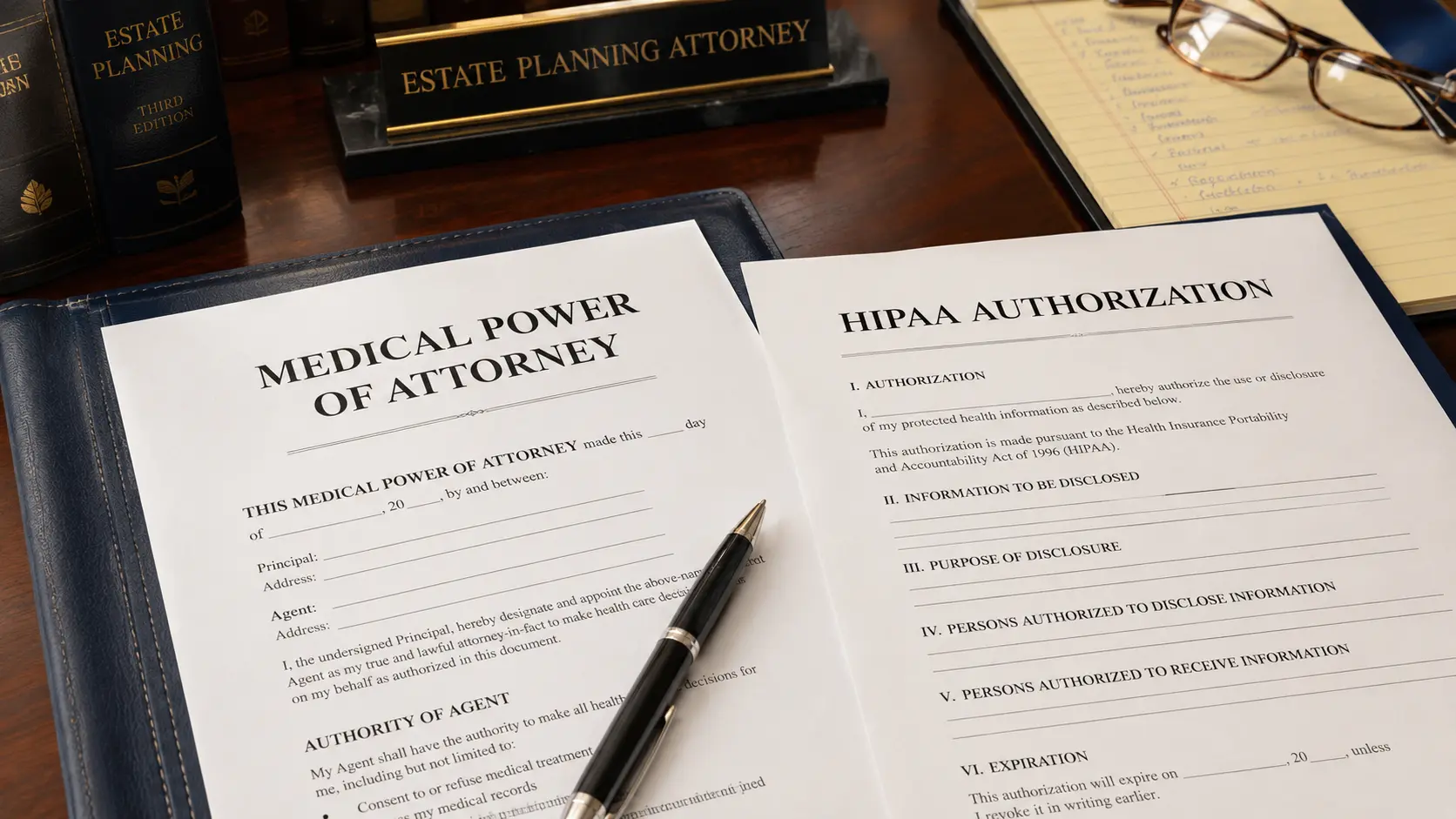
A Medical Power of Attorney names the person who can make healthcare decisions for you if you cannot make or communicate those decisions yourself.
Texas handles advance directives, including medical powers of attorney and directives to physicians, under Texas Health and Safety Code Chapter 166.
This is separate from a financial power of attorney.
A financial agent may be able to deal with money, but that does not automatically make them the right person for medical decisions. A Medical Power of Attorney answers a different question:
Who should doctors speak to when you cannot speak for yourself?
This can matter during surgery, serious illness, an accident, or any medical emergency where decisions need to be made quickly.
The person you choose should be calm under pressure, willing to ask questions, and able to follow your wishes even when other family members disagree.
5. HIPAA Authorization
HIPAA is a federal privacy law. In everyday terms, it affects who can receive your medical information.
The U.S. Department of Health and Human Services explains that healthcare providers may share certain information with family or friends involved in care in some circumstances, but the Privacy Rule does not require a provider to share information unless that person has the proper status or authorization. You can read the HHS explanation here: Family Members and Friends under HIPAA.
That is why a HIPAA Authorization matters.
A Medical Power of Attorney names a decision-maker. A HIPAA Authorization helps that person receive the information needed to understand what is happening.
This is especially important for parents of young adults.
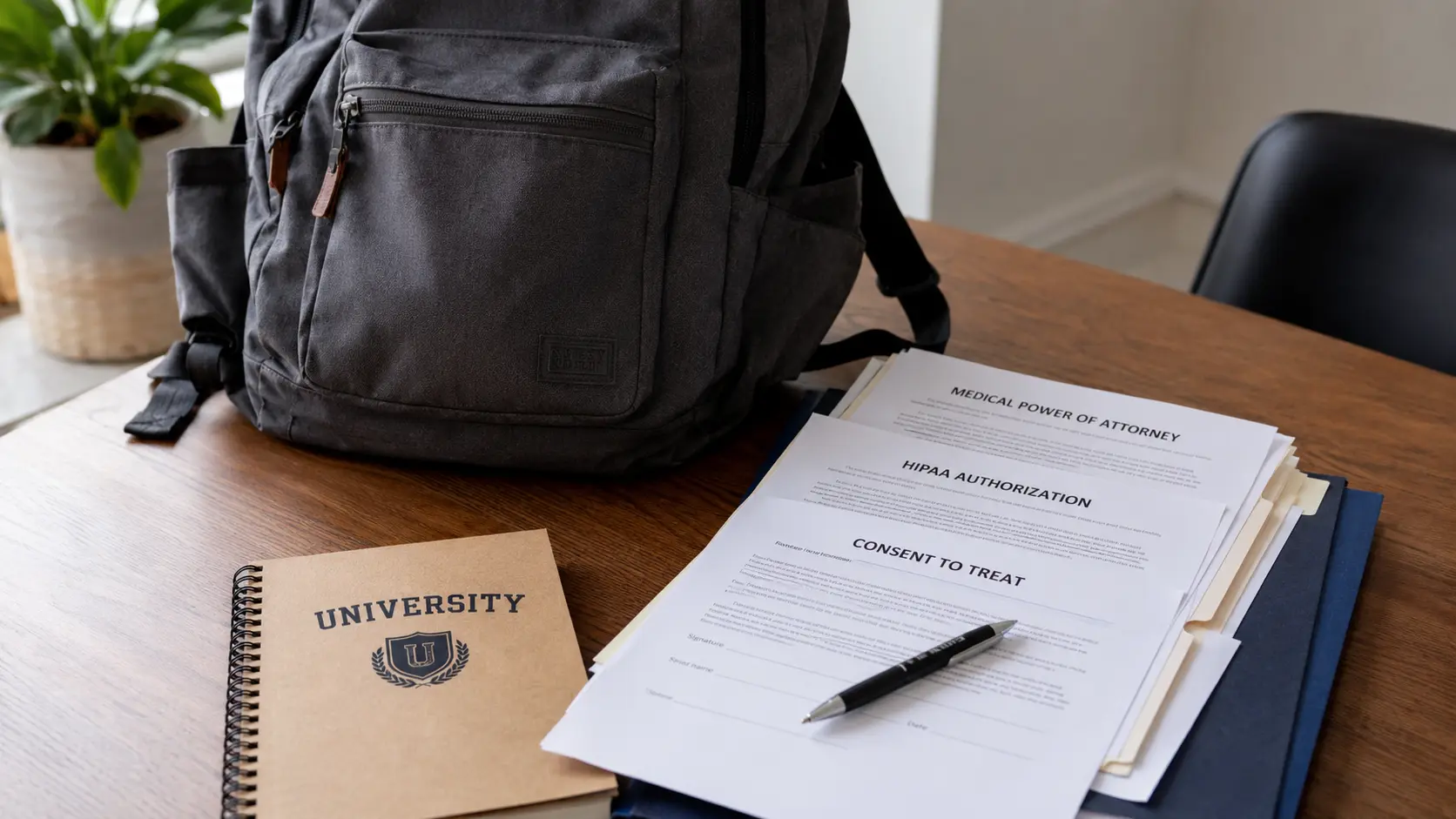
When a child turns 18, that child is legally an adult. Parents do not automatically keep the same access to medical information they had when the child was a minor. If an 18-year-old is away at college, traveling, driving, working, or living independently, three documents become especially important:
- HIPAA Authorization
- Medical Power of Attorney
- Durable Financial Power of Attorney
Many families think of these as “college documents,” but they are really young adult documents.
The legal change happens at 18 whether the child still lives at home or not.
6. Directive to Physicians
A Directive to Physicians is often called a living will.
It states your wishes about life-sustaining treatment if you have a terminal or irreversible condition and cannot communicate your decisions. This is also covered under Texas Health and Safety Code Chapter 166.
This document does not name the person who makes decisions. That is the role of the Medical Power of Attorney.
The Directive to Physicians states your wishes.
For families, this can remove an enormous burden. Instead of asking your spouse, adult children, or relatives to guess what you would want, the document gives them guidance.
That does not make the moment easy. But it can make the decision clearer.
7. Revocable Living Trust
A Revocable Living Trust is not necessary for every Texas family, but it can solve problems that a will alone may not solve.
Texas trust law is addressed in the Texas Property Code, including Texas Property Code Chapter 112.
A properly funded revocable living trust may help with:
- Reducing probate for assets placed into the trust
- Keeping certain family and asset information private
- Managing assets for minor children
- Planning for blended families
- Handling real estate in more than one state
- Creating rules for how and when children receive money
The key phrase is “properly funded.”
A trust only works as intended when the right assets are actually placed into it or coordinated with it. A trust sitting in a folder with no assets connected to it may not accomplish much.
For parents, a trust is often worth discussing when there are minor children, a home, a blended family, privacy concerns, business interests, or a desire to control when children receive money.
The question is not “Does every family need a trust?”
The better question is “What problem are we trying to solve?”
Common Estate Planning Mistakes Texas Families Make

The families who run into trouble are not always the families with no documents. Sometimes they have documents, but the documents are incomplete, outdated, or not coordinated.
Here are common mistakes worth avoiding.
Assuming a Will Avoids Probate
A will gives instructions to the probate court. It does not automatically keep your family out of court.
For some families, probate may still be manageable. For others, especially those with privacy concerns, real estate, or complicated family structures, a trust or other planning tool may be worth discussing.
Naming a Guardian But Not Telling Them
A guardian designation is not only a legal decision. It is a practical one.
The person you name should know they are being named. They should understand the responsibility. They should also know where the documents are kept.
A surprised guardian may hesitate, decline, or become part of a dispute the documents were meant to prevent.
Forgetting Beneficiary Designations
Life insurance, retirement accounts, payable-on-death accounts, and transfer-on-death accounts often pass by beneficiary designation.
That means the form on file may control, even if your will says something different.
This is why estate planning should include a beneficiary review. An old form from a prior job, a prior marriage, or a rushed enrollment packet can create real problems years later.
Not Updating After Life Changes
Estate plans do not update themselves.
Review your plan after major life events, including:
- Marriage
- Divorce
- Remarriage
- Birth or adoption of a child
- A child turning 18
- Death of a named executor, trustee, guardian, or beneficiary
- Buying a home
- Starting or selling a business
- Receiving an inheritance
- Moving to or from Texas
- A major change in family relationships
Even without a major event, reviewing every three to five years is a practical habit.
Using Generic Documents Without Texas Review
Online templates can make estate planning look simple. Sometimes the issue is not whether the form exists. The issue is whether it works for your state, your assets, your family, and your goals.
Texas has its own execution requirements, probate procedures, guardianship rules, healthcare forms, and property laws.
A document that looks official may still miss the problem your family actually needs solved.